


Resource Shortages in EPR Projects: A Structural Reality

There is a further complication: EPR projects do not end at go-live. They transition into operations — and frequently consume more resources than planned. Support volumes rise, clinical teams need ongoing guidance, and Digital Champions become permanently embedded in a role that was originally intended to be temporary. What began as a project becomes a standing commitment.
The bottleneck rarely appears at a single point. It distributes itself across IT, clinical departments, training, change management and operations. Often it remains unclear where resources are actually being consumed — and where targeted relief would be possible.
This article addresses exactly that. It examines the five central areas where resource shortages have the greatest impact on EPR projects and offers a realistic assessment of where relief is achievable — and where it is not. Not as a promise of solutions, but as a practical orientation for decision-makers responsible for EPR programmes under constrained conditions.
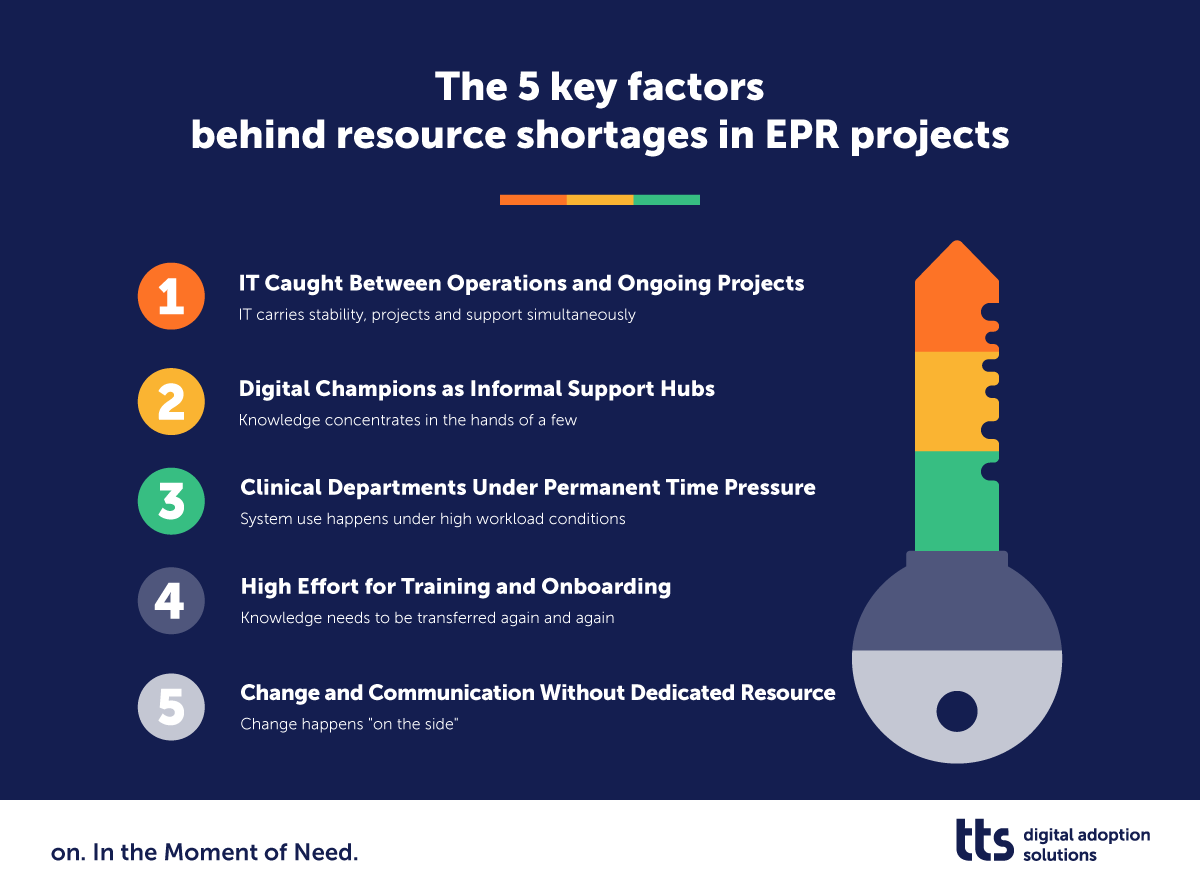
IT and EPR Teams Caught Between Operations and Projects
In many NHS trusts, IT teams carry a dual responsibility. They maintain stable day-to-day operations while simultaneously driving EPR projects forward — from initial implementations to migrations, system releases and functional extensions. Alongside this, they manage a growing portfolio of digital transformation initiatives, including interoperability work within Integrated Care Systems (ICS) and compliance with NHS England's Frontline Digitisation programme.
This parallelism creates sustained resource pressure. Project tasks compete directly with operational demands, and unplanned support issues interrupt planned work. The situation intensifies after go-live: usage-related queries increase, IT becomes the default contact point for clinical uncertainties — even when systems are technically stable.
The result is a familiar pattern. IT teams operate reactively, strategic priorities are deferred, and project timelines come under pressure. The real bottleneck lies less in the technology itself than in how the system is used in everyday clinical practice.
A December 2024 board paper from Wirral University Teaching Hospital NHS Foundation Trust put a number to this: digital healthcare staff vacancies stood at 12.5 %, with the shortage described as having "impacted significantly on operational capacity". This is not an isolated case. Across the NHS, the shortage of specialist Digital, Data and Technology (DDaT) staff has been identified as a structural barrier to digital transformation.
Where relief is possible:
Reducing usage-related support requests can free up meaningful IT capacity. Contextual guidance embedded directly within the EPR addresses recurring questions at the point of need, rather than routing them to the service desk. Structured enablement and change approaches can help reduce support demand over time, not just manage it.
Where the limits lie:
A fundamental shortage of IT personnel cannot be resolved through digital enablement alone. These approaches can relieve pressure, but they do not replace missing headcounts or resolve unclear prioritisation.
Digital Champions as an Operational Bottleneck
Digital Champions play a central role in NHS EPR programmes. They understand clinical workflows, support colleagues, test new functionality and act as the bridge between IT and frontline staff. In practice, however, they typically take on this role in addition to their substantive clinical or operational responsibilities.
After go-live, the situation frequently worsens. Questions do not stop, day-to-day uncertainties land with the Digital Champions, and what was intended as periodic support becomes a permanent burden. Knowledge concentrates in a small number of individuals who effectively become unofficial support hubs.
For the trust, this creates several risks:
- Digital Champions become overloaded.
- Their primary clinical or operational duties suffer.
- When they are absent or leave the organisation, a significant knowledge gap opens up immediately.
The resource shortage here does not manifest as a missing headcount. It manifests as dependency on specific individuals.
The NHS EPR Usability Survey 2024 reinforces this picture: 60 % of doctors and 70 % of nurses said they would welcome additional EPR training. Notably, 44 % reported receiving no further training after joining their organisation. This training deficit lands directly with Digital Champions — who are expected to fill a gap that formal onboarding structures leave open.
Where relief is possible:
Knowledge can be extracted from individual Digital Champions and made available directly within the EPR. Contextual, workflow-embedded support means recurring questions are answered at the point of need. Clear role definitions, realistic expectations and structured enablement frameworks help to stabilise and limit the Digital Champion role.
Where the limits lie:
If Digital Champions are not formally recognised or given protected time, the burden remains regardless of digital support measures. Enablement tools can relieve pressure — but they do not substitute for clear governance around responsibilities and time allocation.
Clinical Departments Under Permanent Time Pressure
Whether an EPR project succeeds in practice is decided on the wards, in outpatient departments, in theatres and in administrative teams. Clinical staff work with the system daily — under significant time and performance pressure. In a shift-based NHS environment, there is rarely space for additional training, follow-up or deeper engagement with new processes.
EPR changes arrive in this environment as an additional layer. New functionality, revised workflows and additional documentation requirements land on a working day that is already tightly scheduled. Uncertainties are not always raised — they are pragmatically worked around. Workarounds emerge, processes are shortened or used differently than intended.
The consequences are direct. Insufficient confidence in system use affects data quality in the EPR. Information is entered incompletely, inconsistently or late. Downstream processes — including coding, reporting and quality assurance — come under pressure as a result. Operations become less stable, correction cycles multiply and support demand increases.
At the same time, acceptance of further change declines. Not from resistance, but because each additional adjustment is experienced as another risk in an already dense working day.
The Health Foundation's 2025 report on EPR strategy in the NHS found that while 93 % of trusts now have an EPR, many are not using them to meaningfully improve care quality, staff experience or productivity. The gap between deployment and genuine adoption is real — and it is widest where clinical teams have the least capacity to engage.
Where relief is possible:
Support embedded directly in the clinical workflow can meaningfully reduce pressure. Contextual guidance within the EPR increases confidence in system use precisely in the moments when data needs to be captured correctly and completely. Realistic change and qualification frameworks help make the connection between system use, data quality and operational stability visible to clinical teams.
Where the limits lie:
Structural understaffing in clinical operations cannot be compensated for through digital enablement. These approaches can reduce risk and protect quality — but they do not replace missing clinical resource.
Training, Knowledge Transfer and Onboarding Under Sustained Pressure
Training and qualification are indispensable in EPR projects. At the same time, they are among the areas where resources run short most quickly. Classroom training is time-intensive, difficult to schedule and hard to scale in a shift-based NHS environment. Digital learning formats help, but do not fully resolve the underlying problem.
The pace of change compounds this. Content becomes outdated quickly, new functionality requires updates, and with staff turnover or agency personnel, onboarding starts again from scratch. The effort distributes itself across numerous training sessions, repeated explanations and individual queries.
The effects are visible in daily practice. Knowledge exists in principle, but is not always available where it is needed. Under time pressure, staff fall back on assumptions or established habits. This not only increases support demand — it affects the quality of data entry when functions are used incompletely or process steps are skipped. Corrections happen after the fact and consume additional resource.
The EPR Usability Survey 2024 data is unambiguous: the majority of clinical staff want more training, and nearly half received none after joining their organisation. This is not a marginal finding. It points to a systemic gap between the investment made in EPR deployment and the investment made in sustained adoption.
Where relief is possible:
Closer integration of learning and working can provide meaningful relief. Support embedded directly in the EPR reduces the need for repeated training sessions and makes knowledge available at the moment of application. Didactically structured qualification frameworks help to focus learning content on critical usage situations, rather than delivering it broadly and abstractly.
Where the limits lie:
Mandatory training requirements, professional certifications and regulatory obligations cannot be replaced by digital enablement. The initial qualification effort for complex systems remains. Digital enablement approaches can, however, help to distribute this effort more effectively and reduce it over time.
Change and Communication as an Afterthought
Change is a constant in EPR projects. New processes, revised workflows, additional documentation requirements and shifting roles are part of the landscape. Yet change management is frequently not planned as a standalone workstream — it is absorbed into the margins of project management, IT or Digital Champion responsibilities, alongside everything else.
Communication then happens reactively, often technically framed and under time pressure. Clinical departments learn about changes late, or in a form that provides little practical orientation. What is changing in the system may be communicated — but why it is changing, and what it means for day-to-day clinical work, often remains unclear.
The consequences emerge quickly. Uncertainty rises, rumours fill the gap, acceptance falls. Changes are implemented hesitantly or only partially adopted. This not only delays project progress — it generates additional resource consumption in operations. Queries increase, coordination multiplies, and IT and clinical teams are drawn into reactive correction.
NHS England has recognised this. The Frontline Digitisation Support Offer (FDSO) now includes a Tiger Team service — cross-functional private sector teams available to provide rapid on-site support at critical points in an EPR journey. This is a direct response to the reality that change and adoption challenges are not solved by technology alone.
Where relief is possible:
A structured change approach creates clarity. Early involvement of relevant stakeholders, communication aligned with actual usage situations, and a clear separation between information, qualification and support measurably reduce pressure on project teams. Guidance embedded directly in the clinical workflow helps to anchor change where it needs to be implemented.
Where the limits lie:
Change cannot be delegated or automated. Missing prioritisation, unclear decisions or insufficient management backing cannot be compensated for by good frameworks. Enablement can support — but responsibility for change remains a leadership task.
Conclusion: Recognising Resource Shortages Means Targeting Relief
Resource shortages in EPR projects are rarely the result of individual decisions. They arise where high complexity, sustained change pressure and limited personnel capacity converge. For many NHS trusts, this is not a temporary problem — it is a structural condition.
The critical question for CIOs and digital leads is not whether resources are constrained, but where they are being consumed. This article has identified five central bottlenecks: IT and EPR teams caught between operations and projects, overloaded Digital Champions, clinical departments under time pressure, training structures under sustained demand, and change and communication running as an afterthought.
Not every bottleneck can be resolved. Staff shortages, regulatory requirements and structural constraints remain. At the same time, examining these pressure points reveals that a significant portion of resource consumption is generated by uncertainty, repetition and reactive correction.
This is where effective levers lie. Where system use becomes more confident, where knowledge is available within the workflow, and where change is communicated in a way that makes sense to frontline staff — support demand falls, corrections decrease and escalations become less frequent. Relief does not come from additional projects. It comes from targeted measures that stabilise operations.
For NHS CIOs, this means: resource shortage is not purely a quantitative problem. It is also a question of enablement, change management and how EPR projects are integrated into clinical practice. Taking this perspective creates room for strategic control — even under constrained conditions.


