


Adoption in RISE with SAP: Growth driver instead of cost factor

Organizations invest significant amounts in implementation, migration, and integration. However, the true value is only realized when employees understand and accept the new system and integrate it into their daily work. This is precisely where it is determined whether a RISE project will lead to greater efficiency, agility, and transparency in the long term – or fall short of expectations.
Adoption is therefore not a “soft” issue. It is the lever that determines whether technology becomes a growth driver or a cost factor. And it begins long before go-live – namely with a clear vision, targeted communication, and a structured change management approach.
Why adoption is not a side issue in RISE projects
Many RISE with SAP initiatives focus on technical migration: systems are consolidated, processes harmonized, and data cleaned up. In the process, the technical and organizational dimensions of change often take a back seat. At least until shortly before go-live. Then suddenly, “change management” is supposed to fix everything.
But genuine acceptance does not come about through a few training sessions or newsletters. It is the result of a continuous process that involves all those affected, from management to end users. Adoption means that new systems are not only operated, but understood, accepted, and used in everyday life.
Why is this so crucial? If users continue to think in terms of old workarounds, the potential of SAP S/4HANA remains untapped. Shadow processes emerge, the number of support requests increases, and the benefits of the project evaporate.
RISE with SAP projects are complex transformation programs. And as with any transformation, people do not automatically adapt to change. They need guidance, meaning, and tangible benefits. Those who take these factors into account early on and consistently build trust, and thus lay the foundation for sustainable success.
The underestimated stumbling blocks in adoption
Why does so many RISE with SAP projects fail not because of the technology, but because of how it is used? Often, it is the same recurring hurdles that differ only in their severity. Those who recognise them early on can take targeted countermeasures.
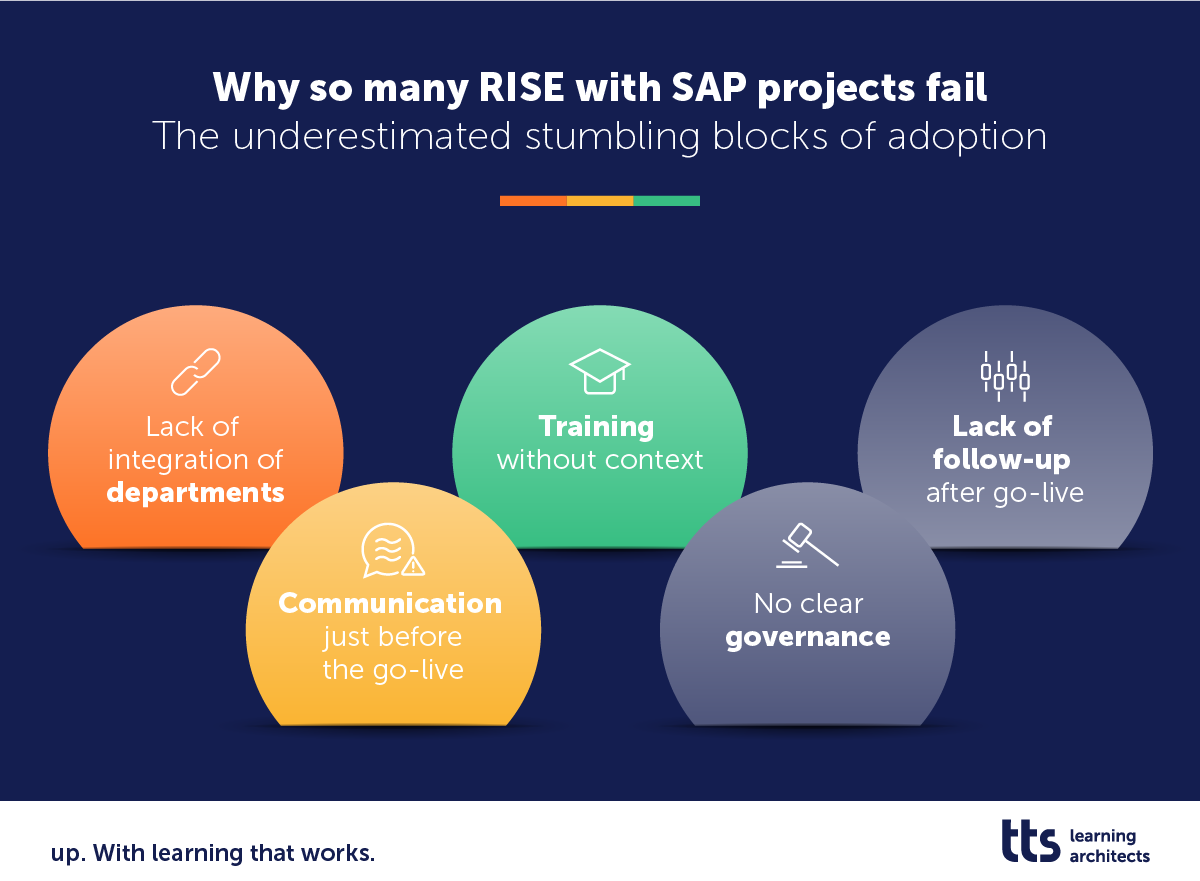
1. Lack of involvement from specialist departments
When IT takes sole control, important perspectives go unheard. Key users know best how their processes actually work and where practice deviates from theory. Without their active participation, there is a risk of ending up with a system that is technically flawless but not accepted in everyday use.
2. Communication only shortly before go-live
Many projects underestimate how early people need guidance. If those affected only find out what is changing weeks before the launch, this creates uncertainty – and resistance. Clear, continuous communication, on the other hand, creates trust and acceptance.
3. Training without context
Standardised training courses are important, but they are not enough. Employees need to understand why they are doing something and how it helps them to do their jobs more easily or better. Only then can real benefits be achieved – and with them the motivation to embrace the new.
4. No clear governance
Adoption is not a ‘soft’ topic for HR or communications. It belongs in line management – with clearly defined roles, KPIs and responsibilities. If no one is responsible, adoption remains a good intention without effect.
5. Lack of follow-up after go-live
Many companies treat go-live as the goal – but it is only the starting point. Without ongoing monitoring, feedback loops and improvement cycles, there is a risk of falling back into old habits. This means that progress is lost faster than it was achieved.
These stumbling blocks show that adoption is not a matter of chance. It requires planning, accountability and, above all, the right attitude. The success of a RISE project is measured by actual usage, not by adherence to the project plan.
How adoption will lead your RISE project to success
Sustainable adoption does not happen by chance. It is the result of a clear approach that takes technology, processes and people equally into account. If you want to successfully implement RISE with SAP, you need a well-thought-out concept. One that grows with the project from day one and is not just added at the end.
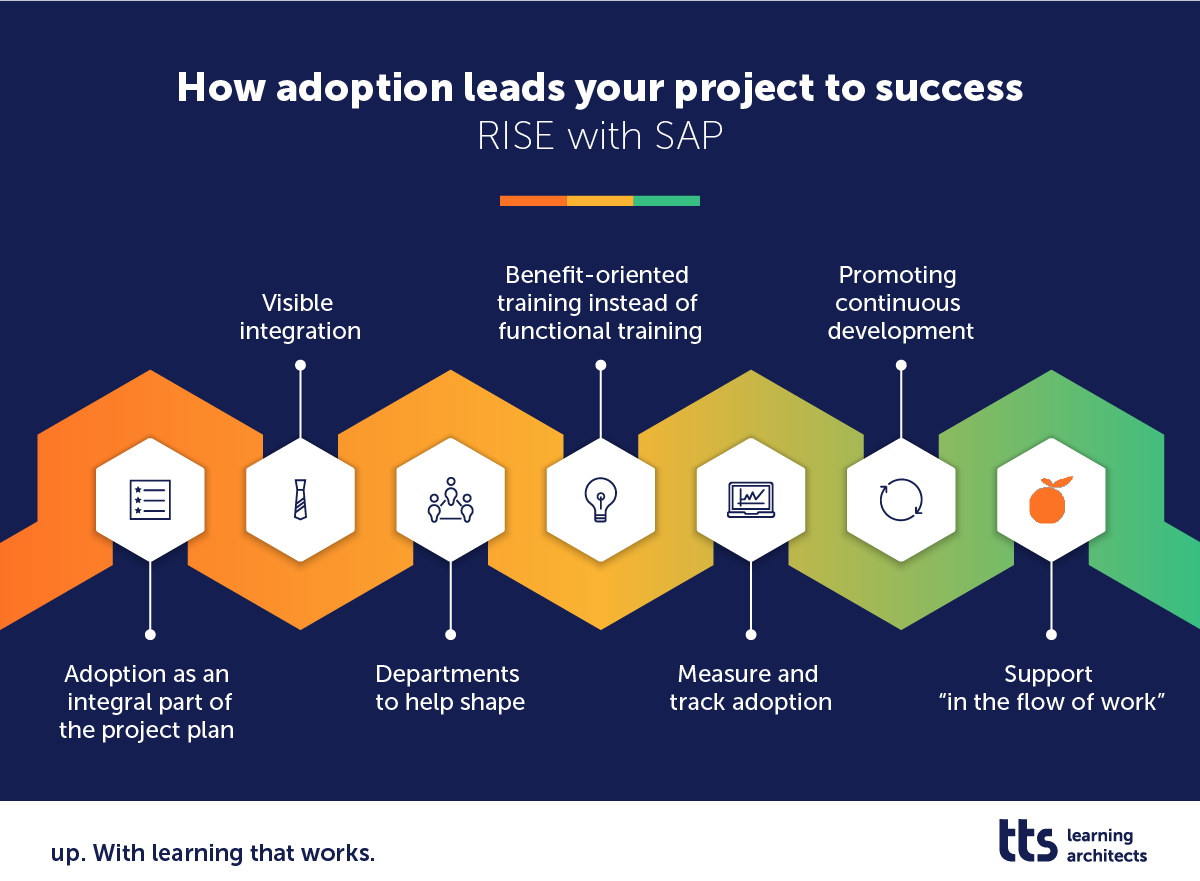
1. Make adoption a key part of the project plan
Adoption isn't just a side issue, it's a whole workstream in itself. Plan resources, milestones, and KPIs for using the system just as carefully as you do for technical deliverables. This turns change management into a measurable success factor.
2. Get leadership involved in a visible way
Adoption only works if management is convinced and shows it. When C-level and IT management regularly communicate why RISE with SAP is strategically important, it creates orientation. Employees understand: ‘This is not an IT project, but a future project for the entire company.’
3. Make departments co-creators
Don't wait until the processes are already set in stone to invite the departments to participate. Involve key users early on in design, testing, and feedback. This creates personal responsibility and greatly increases acceptance.
4. Benefit-oriented training instead of functional training
Instead of purely functional training formats, learning opportunities are needed that demonstrate concrete benefits. Which tasks become easier? Where are sources of error reduced? How does the system save time? This creates genuine understanding and motivation.
5. Measure and track adoption
Only what is measured can be controlled. Define clear KPIs, e.g. usage rates, process throughput times or self-service quotas. Use feedback loops to identify early on where support is needed.
6. Promote continuous development
After go-live is before the next improvement. A vibrant adoption culture means that teams regularly test new features, share best practices and learn from each other. This ensures that RISE with SAP is not only introduced, but also lived on a permanent basis.
7. Enable digital support ‘in the flow of work’
Even the best training is useless if it cannot be accessed in the hectic day-to-day work routine. This is where digital adoption platforms (DAPs) such as the tts performance suite come into play. They support users directly at the moment of use – where questions arise and decisions are made. Step-by-step instructions, context-sensitive help and micro-learning ensure that knowledge remains available. This prevents errors and makes the transition phase after go-live noticeably smoother.
Those who understand adoption in this way achieve more than just system acceptance. They lay the foundation for an agile, adaptive organisation – one that does not fear change, but embraces it.
Strategic benefits: When adoption has an impact
When the implementation is truly successful, i.e., when departments, IT, and management are all on the same page, the new system is understood, and everyone is using it, then RISE with SAP unfolds its full potential.
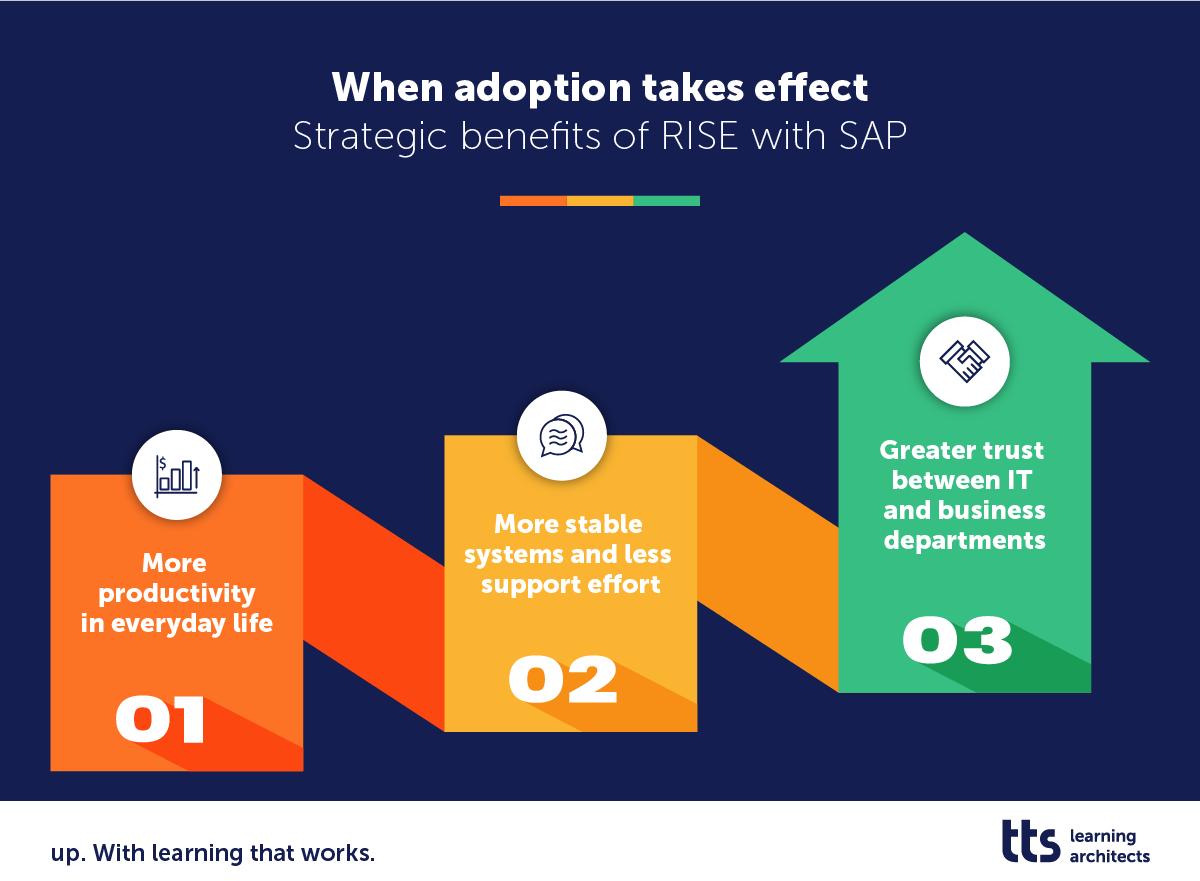
Greater productivity in everyday work
Well-trained users who receive reliable support work faster and more accurately. Tasks are completed more efficiently and error rates are reduced. Digital assistance ‘in the moment of need’ allows tasks to be completed immediately. Time-consuming queries to colleagues or detours via support are avoided.
More stable systems and less support effort
A well-thought-out adoption process reduces typical user errors and thus support tickets. This relieves IT teams, lowers operating costs and creates space for more strategic tasks. As a result, the system landscape remains not only stable but also sustainably maintainable.
Stronger trust between IT and business departments
Nothing strengthens the relationship between IT and business more than tangible benefits. When business departments experience that new solutions actually improve their everyday work, trust is created. IT is no longer perceived as a mere service provider, but as an equal partner.
Conclusion: Adoption is not a cost factor, but rather an investment in success.
RISE with SAP is an ambitious program – technologically, organizationally, and in terms of human resources. But its real success is not measured by the number of systems migrated or workstreams completed. It is measured by the way people work with the new system, how naturally they use it, think ahead, and develop it further.
Adoption is therefore much more than change management. It is the key to anchoring change, keeping knowledge alive, and making the organization fit for the future. Investing in structured adoption at an early stage reduces risks, strengthens collaboration, and significantly accelerates the return on investment.
RISE with SAP is an invitation to rethink technology, processes, and learning culture. And that is precisely where sustainable success begins: with the people who work with the system every day.
FAQ
What does “adoption” mean in the context of RISE with SAP?P?
Adoption describes the process in which employees not only learn about new systems, processes, and ways of working, but also actively apply them and incorporate them into their daily work. It is therefore not just a matter of operating the system, but of embracing change in a lasting and productive way.
Why is adoption particularly important at RISE with SAP?
RISE with SAP not only changes the technical platform, but also roles, responsibilities, and processes. If users continue to work in old patterns of thinking, potential remains untapped. Only through targeted adoption can real added value be created in the form of efficiency, quality, and trust between IT and business.
How does a digital adoption platform (DAP) such as the tts performance suite support adoption?
A DAP such as the tts performance suite accompanies users directly in their work process. It offers context-sensitive help, step-by-step instructions, and short learning prompts exactly when they are needed. This reduces support costs, prevents errors, and ensures that knowledge is retained in the long term.
When should a DAP be integrated into the project?
Ideally, right from the start. This allows learning content, process instructions, and support to be developed in parallel with the system rollout. If the platform is only introduced after go-live, valuable learning effects are lost. Early integration, on the other hand, enables a smooth transition to “business as usual.”
What are the measurable benefits of consistent adoption?
- Faster time-to-value through productive use from day one
- Fewer support tickets and reduced IT workload
- Higher data quality due to fewer application errors
- Better collaboration between IT and business departments
- Sustainable learning culture and increased willingness to change
How can the success of adoption be measured?
With KPIs that go beyond pure project metrics. These include, for example, usage rates, error frequencies, process runtimes, or feedback scores. Combined with qualitative feedback, this provides a complete picture that shows whether the new way of working is actually being put into practice.


