

Why communication is an underestimated key element in S/4HANA projects

This does not mean a series of informational emails or occasional project updates, but rather communication that provides orientation, addresses target groups in a differentiated manner, and thus enables people step by step to understand, support, and ultimately implement change.
In practice, it has been shown time and again that it is not the technology that determines the success of an S/4HANA project, but rather the question of whether it is possible to meaningfully engage the organization over a period of months, or in some cases years.
Dr. Katharina Vögl-Duschek, Senior Learning Consultant, tts learning architects
Why communication in S/4HANA projects needs to be approached differently
Traditional change approaches often reach their limits in ERP transformations. And for good reason:
- Communication gaps: A lot happens in a project between the design, build, and test phases, but often little of it is visible within the organization.
- Profound changes to routines: Standardization affects not only processes, but also established ways of working and identities.
- Long project durations: What is explained today is often forgotten or partially obsolete in six months.
The result: Employees lose sight of the “why?”, the concrete “what does this mean for me?” and, as a result, often also their confidence in their ability to cope with the new.
Effective change communication must therefore do more than just inform. It must continuously contextualize, create meaning, facilitate dialogue, and prepare for learning – throughout the entire project duration.
ADKAR as a pragmatic orientation framework
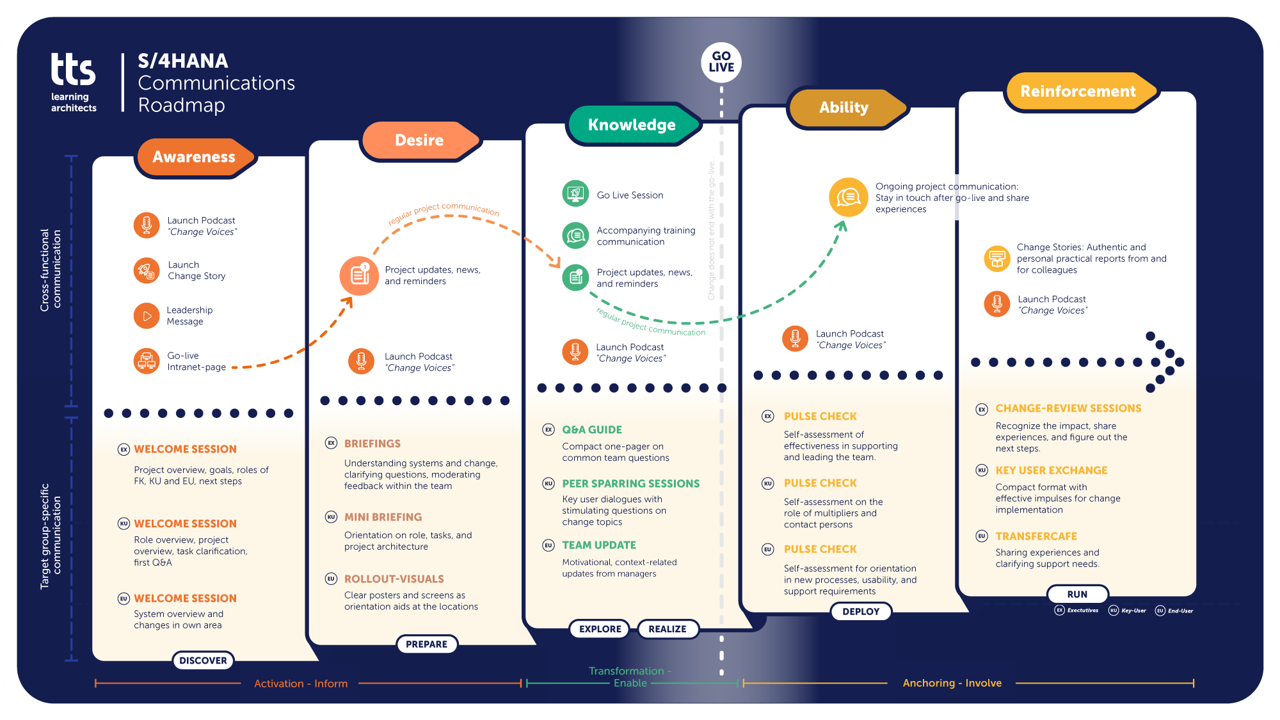
Over the past few years, we have developed a practical S/4 Change Communication Starter Kit that is deliberately based on the ADKAR phases, but in a way that can be pragmatically implemented in real projects.
Communication is
- planned in phases,
- tailored to specific target groups, and
- cascaded – for managers, key users, and end users.
Each ADKAR phase answers a different question that is crucial to the success of the project:
- Awareness: Why is this change happening and why now?
- Desire: Why should I personally get involved?
- Knowledge: What exactly can I expect, both technically and organizationally?
- Ability: How do I implement the new changes in my everyday work?
- Reinforcement: How can the change remain effective in the long term?
Why we work with three target groups
S/4HANA transformations affect many people. However, experience shows that not all target groups need the same type of communication at the same time. We therefore deliberately focus on three groups that have a significant influence on the success of the project:
Managers
They shape meaning, priorities, and attitudes in everyday life. Their classification determines whether employees gain orientation or experience uncertainty. Managers are not merely recipients of communication, but key multipliers.
Key users
Key users operate at the interface between the project and the specialist department. They understand processes, know the reality of day-to-day business, and are often the first point of contact for questions. When well integrated, they become translators and amplifiers of change.
End users
End users experience change directly in their daily work. They decide whether new processes are accepted, understood, and applied. Their perspective is central to sustainable anchoring.
These three groups form the communication cascade of our roadmap.
This transforms change communication in S/4HANA projects from an accompanying information channel to a structured lever for transformation.
In the following articles, we will show how this approach can be implemented in practice along the ADKAR phases.


