


From risk to resource: Stakeholders as a success factor in SAP S/4HANA transformation

The other perspective on stakeholders
SAP S/4HANA transformations are not just IT projects: they change processes, roles, and thus also daily collaboration in many areas. For this change to succeed, more than just technical implementation is needed. People who understand, support, and shape the change are crucial.
Stakeholders play a key role in this. These include individuals or groups of people who are not directly part of the project team but who can significantly influence the success of the project. Typical stakeholders include managers, affected employees, and customers. They are often considered a risk: potential obstacles that need to be “managed” or “convinced.” We take a different view: Stakeholders are not an obstacle, but a resource. They bring knowledge, experience, and networks that are crucial to the success of the project. So the question is: How can you win stakeholders as co-creators in the SAP S/4HANA transformation?
From a risk perspective to a resource perspective
Why is it worthwhile to view stakeholders as more than just a group to be managed? Because they exert influence regardless of whether they play an active role or not. Those who do not feel involved will seek their own paths, inform themselves, or question decisions. Those who are perceived as relevant partners, on the other hand, contribute knowledge, ideas, and acceptance.
Stakeholder engagement therefore means more than just informing relevant key individuals about the current status of the project. It means continuously involving stakeholders, engaging in dialogue with them, and actively using their knowledge and experience to ensure the success of the project. In this way, stakeholders become partners in the transformation and help to ensure that changes are understood, accepted, and implemented in a sustainable manner.
Our approach: Stakeholder analysis step by step
To ensure that stakeholders become co-creators of the SAP S/4HANA transformation, we rely on a structured and resource-efficient approach.
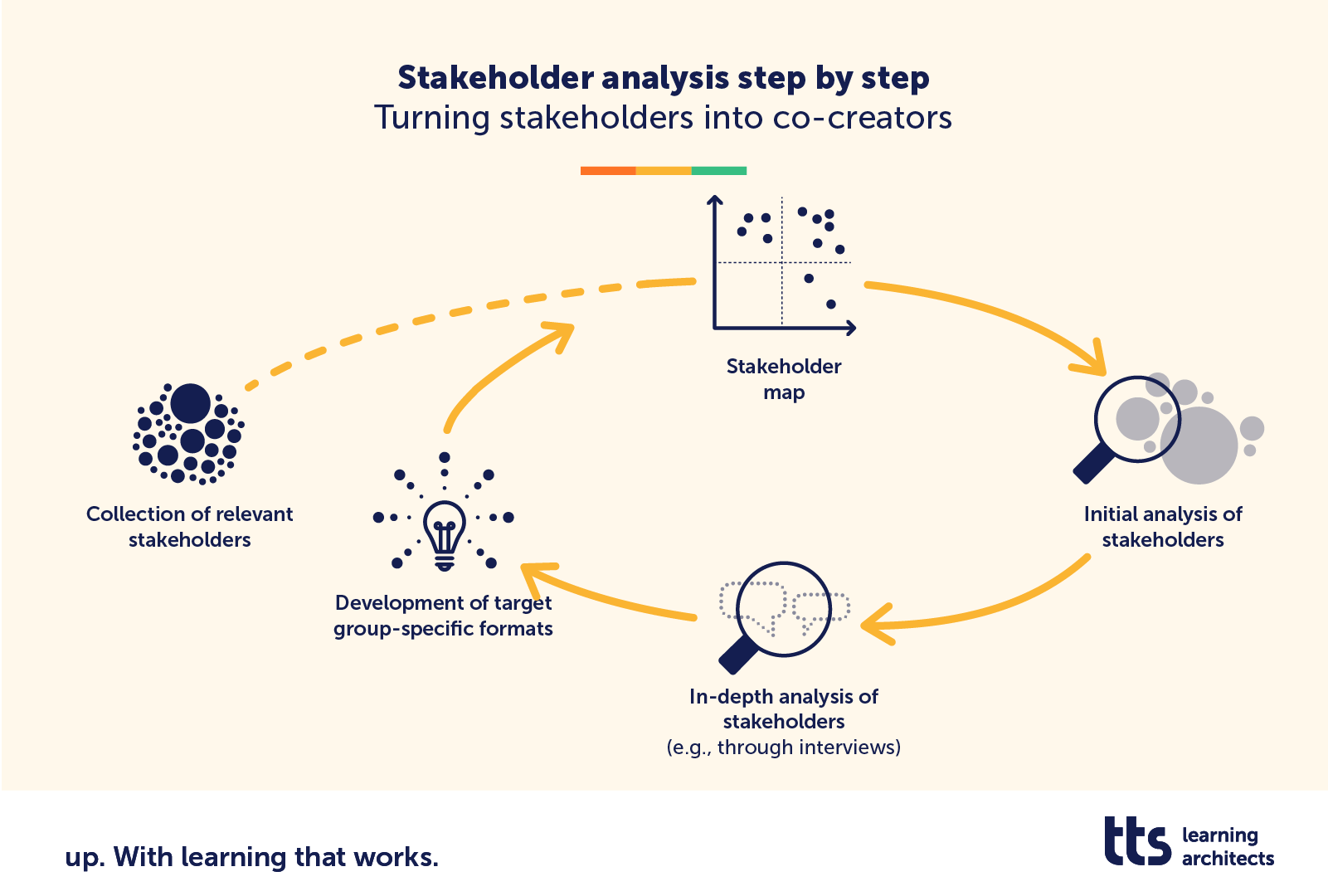
1. Gathering relevant stakeholders
The project team identifies which individuals or groups of people play a role in the success of the project.
2. Stakeholder map
The project team uses a stakeholder map to visualize all relevant actors: Who has the greatest influence? Who has the potential to provide active support? The result shows at a glance who to work with in greater depth.
3. Initial analysis of stakeholders
A closer look at selected actors based on the stakeholder map. This analysis shows the interests, influence, and attitudes of the identified stakeholders. This analysis provides the basis for setting priorities and strategically aligning the next steps.
4. In-depth analysis of stakeholders (e.g., through interviews)
We conduct interviews with selected key individuals to gain a better understanding of their expectations, needs, and concerns: What does the person need to support the change? What concerns do they have? What strengths and resources can they contribute to the project?
5. Development of formats
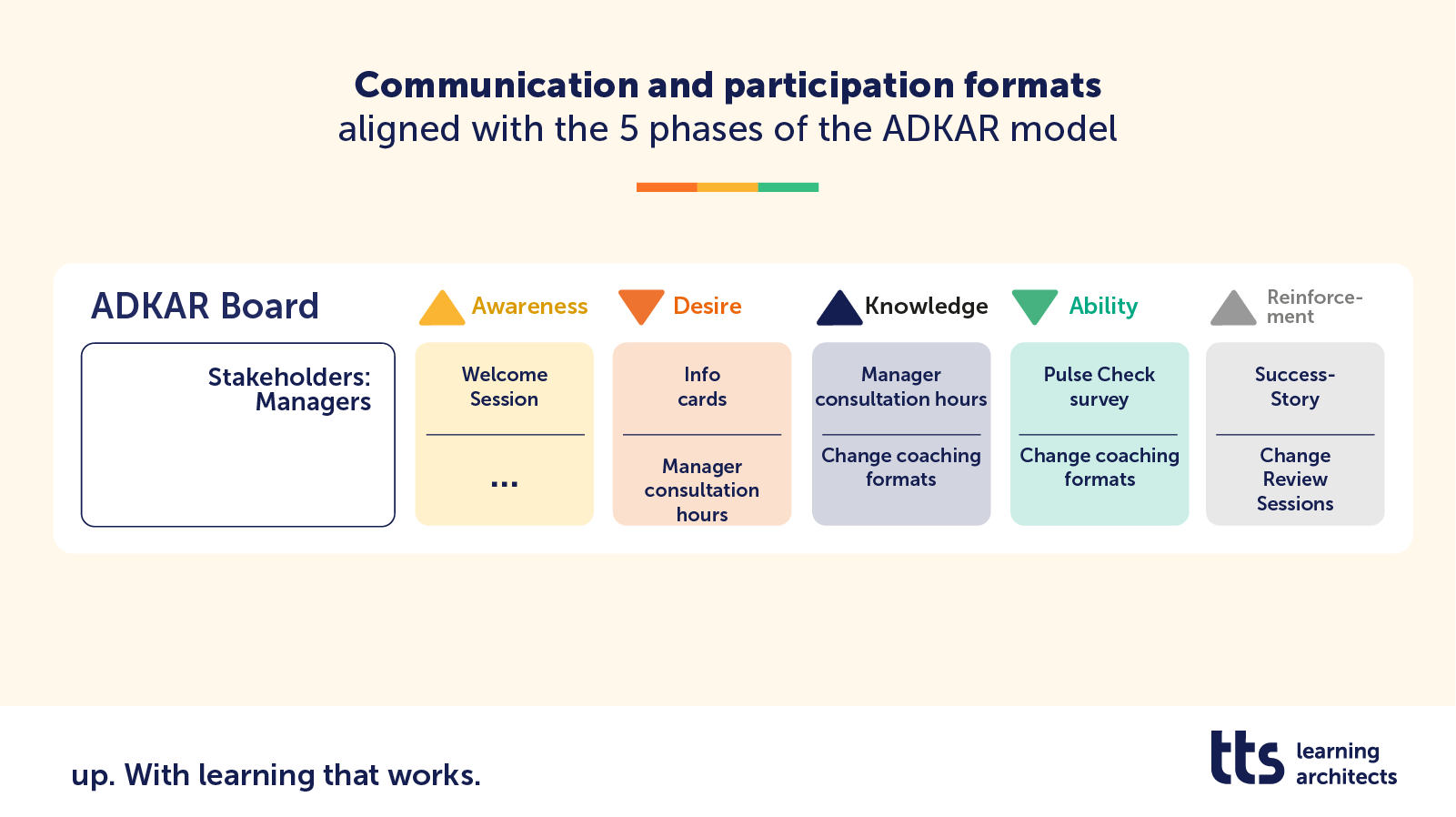
Based on the analysis, we develop formats that both inform and actively engage. We use the phases of the ADKAR model as a guide to provide appropriate impetus in each project phase.
Dynamic approach instead of one-time measures
Stakeholder engagement is not a one-off step, but an ongoing process throughout the entire course of the project. The analysis at the beginning provides guidance, but needs and priorities may change over the course of the project. The project team remains in regular contact with the identified stakeholders via the participation formats developed in step 5. In addition, regular check-ins help to validate the stakeholder map and expand it as needed. If new key individuals join, they are added and interviewed if necessary. In this way, formats can be adapted and further developed as soon as the reality shifts.
We align our communication and participation formats with the five phases of the ADKAR model:
What the project team gets out of it
Strong stakeholder engagement not only has an external impact, but also takes the pressure off the project team:
- Better orientation: A clear overview of roles, needs, and expectations.
- Active support: Multipliers in the specialist departments who help shape and support the transformation.
- Less friction: Conflicts and resistance are identified and addressed at an early stage.
- Faster progress: Decisions and implementation steps run more smoothly because key roles are on board.
The result: An IT project becomes a real transformation that moves the organization forward.
Conclusion & Impulse
Stakeholders are not a target group that “only” needs to be informed. They are partners whom we involve and whose resources we actively utilize. Those who dare to change their perspective will encounter less resistance and more participation, energy, and acceptance in the project.
Our invitation: Rethink stakeholder engagement. Not as a risk that needs to be managed, but as a resource that you can leverage for your SAP S/4HANA project.


