


The best digital adoption platform for SAP S/4HANA

Many project teams are familiar with this area of tension. As the go-live date approaches, the pressure on key users and IT to create training materials, keep track of changes, and prepare for ongoing operations at the same time grows. Traditional documentation in Word and PowerPoint quickly reaches its limits. And even with a lot of effort, there is often a feeling at the end that it should all be easier.
That's why more and more organizations are turning to digital adoption platforms. They bring knowledge where it's needed—right into the workflow. But only a solution that also fully integrates documentation and training material creation can unleash the full potential of a DAP.
The tts performance suite was developed precisely for this purpose: it combines efficient content creation, high-quality training formats, and context-sensitive support in the system to form a holistic enablement approach. And it not only reduces the burden on IT, but above all on key users. From project start to stable operation.
Why does SAP S/4HANA require a new type of enablement?
SAP S/4HANA creates a whole new need for guidance. Many stakeholders are wondering where a process begins, how decisions affect other areas, and how all of this can be applied securely in day-to-day business. At the same time, responsibilities and working methods are changing. Processes are in flux – and employee enablement should accompany this movement.
The pace of change is accelerating. Knowledge is becoming obsolete faster than ever before, and training courses that have already been created can hardly keep up with this speed. Many project teams move between project setup, test phases, and data migration, while at the same time being expected to reliably empower all end users. It's no wonder that traditional training formats often reach their limits. A seminar teaches the basics, but rarely reaches employees in their specific work context. And a manual is of little help when a Fiori app suddenly includes a new feature.
This raises a key question: How can knowledge be made available in such a way that it remains effective in a dynamic SAP environment? The answer lies in enablement that provides continuous support, responds to specific contexts, and makes content available exactly where it is needed: directly in the system.
Digital adoption platforms create the foundation for precisely this. They offer much more than training materials and accompany employees through all changes from the start of the project to operational implementation.
What should a digital adoption platform be capable of in an S/4HANA project?
S/4HANA projects affect processes, roles, and the daily work of many people simultaneously. This is precisely why a significant amount of effort is required in five areas that have a decisive influence on the success of the project.
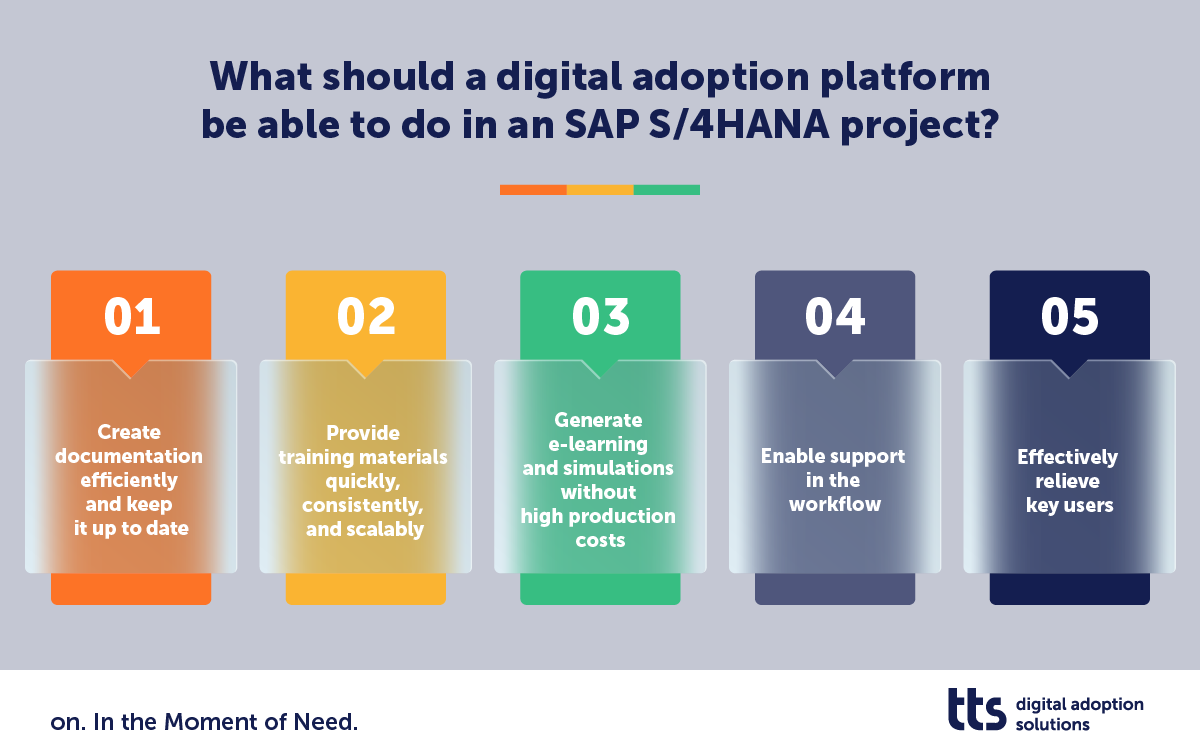
1. Create documentation efficiently and keep it up to date
Each sprint brings new or changed processes. These must be documented in a way that is understandable, complete, and audit-proof. Many teams use Word, PowerPoint, or screenshots for this purpose. This leads to isolated files, duplication of work, and a high maintenance effort as soon as something changes. A powerful DAP should centralize and facilitate precisely these tasks.
2. Provide training materials quickly, consistently, and scalably
An S/4HANA transformation creates training needs for numerous roles and countries. It is hardly feasible to manually create or adapt each document again. Different writing styles and formats also make it difficult to convey knowledge in a consistent manner. A DAP should therefore be able to output content in a structured, efficient, and consistent manner.
3. Generate e-learning and simulations without high production costs
Learning modules and simulations are a central component of every successful rollout. However, manual production is time-consuming and requires specialist knowledge. Even small process changes lead to a lot of rework. A DAP should generate these formats from the same source.
4. Enable support in the workflow
Training courses teach the basics, but the crucial questions arise in everyday life: Where can I find this function? How do I use this Fiori mask? What does this field mean? A DAP should provide answers directly in the system and support users exactly when they need guidance.
5. Effectively relieve key users
Key users are in high demand in S/4HANA projects. They test processes, explain procedures, answer questions, and accompany training courses. When the flow of knowledge depends on a few individuals, bottlenecks arise. A DAP should make knowledge widely available so that key users no longer have to answer every question individually and can regain time for their actual tasks.
Why traditional tools fail: The fragmented content lifecycle as a cost trap
Many project teams initially resort to familiar tools such as Word, PowerPoint, or simple screenshot tools. These solutions seem pragmatic, but they generate isolated content without a consistent structure. Every process change leads to manual rework in multiple documents—with increasing effort and susceptibility to errors.
The lack of versioning is particularly critical. In S/4HANA projects, processes are constantly changing, but traditional documents do not provide transparent traceability of which version is current, what changes have been made, and to which system status they belong. This complicates coordination, jeopardizes compliance requirements, and makes sustainable documentation nearly impossible.
Instead of a clear, traceable documentation history, a hodgepodge of files, versions, and storage locations emerges. Training materials further exacerbate this problem, as different versions are in circulation at the same time. Key users spend a lot of time explaining, correcting, or recreating content.
In addition, traditional tools deliver knowledge before or after work, but not during the workflow. Users are left without support precisely when guidance is most urgently needed.
A fragmented approach without central versioning ties up time, creates dependencies, and increases project risks. For a dynamic S/4HANA environment, this is neither scalable nor sustainable.
The solution: The tts performance suite as a comprehensive digital adoption platform for SAP S/4HANA
An S/4HANA transformation requires enablement that works at the same speed as the project itself. This is precisely why the tts performance suite was developed. It combines the entire value chain of user enablement in a single platform – from initial process mapping to context-sensitive support in the workflow. This creates a consistent content lifecycle that reduces effort and ensures quality.
At its core, the tts performance suite follows a simple but effective approach: capture process knowledge once, use it many times. A single entry in the SAP system automatically generates documentation, training materials, e-learning courses, simulations, and step-by-step instructions. This single source of truth approach ensures that content does not have to be created multiple times, changes remain traceable, and it is always clear which content belongs to which process or system status.
At the same time, the platform makes knowledge available where employees need it: directly in their workflow. Context-sensitive support helps with new screens, unfamiliar transactions, or rarely used processes. Users receive guidance at exactly the right moment – without a manual, without long searches, and without having to ask key users for help.
Another advantage becomes apparent in international projects. Many S/4HANA programs span multiple regions and languages. The tts performance suite supports this global approach with integrated translation functions that automatically localize all content—from documentation and e-learning to in-app help. Language variants are managed centrally and remain synchronized throughout the entire project. Particularly helpful: content in context-sensitive support can be automatically translated into the user's native language as required, without any manual translation effort. This reduces language barriers, accelerates global rollouts, and significantly reduces the workload for local key users.
Thanks to this integrated approach, the tts performance suite grows with the project. It supports the setup, accompanies go-live phases, and ensures stable processes during ongoing operations. Whether changes arise from SAP updates, new roles, or process optimizations, enablement remains up to date and compatible. In this way, the tts performance suite creates an enablement ecosystem that not only introduces S/4HANA, but also makes it sustainable in the long term.
The end-to-end approach: Why it is indispensable for S/4HANA
An S/4HANA transformation does not end with go-live. Processes continue to change, roles evolve, and SAP updates constantly bring new features. That is precisely why an S/4HANA program requires enablement that supports the entire lifecycle—not just individual project phases.
The end-to-end approach of the tts performance suite creates precisely this continuity. The process knowledge gained during the project flows directly into training materials, simulations, and context-sensitive support in the system. Changes that occur in later phases can be updated without media discontinuity and are immediately available in all relevant formats.
This means that knowledge does not remain with the project team, but accompanies employees through implementation, go-live, and ongoing operation. New functions are understood more quickly, errors are reduced, and support teams are noticeably relieved. Above all, a flow of knowledge is created that develops dynamically with the system.
This makes it clear why a consistent enablement approach for S/4HANA is so effective: it makes organizational changes just as connectable as technical ones – and creates the basis for sustainable adoption.
Measurable impact: How the tts performance suite increases the success of an S/4HANA project
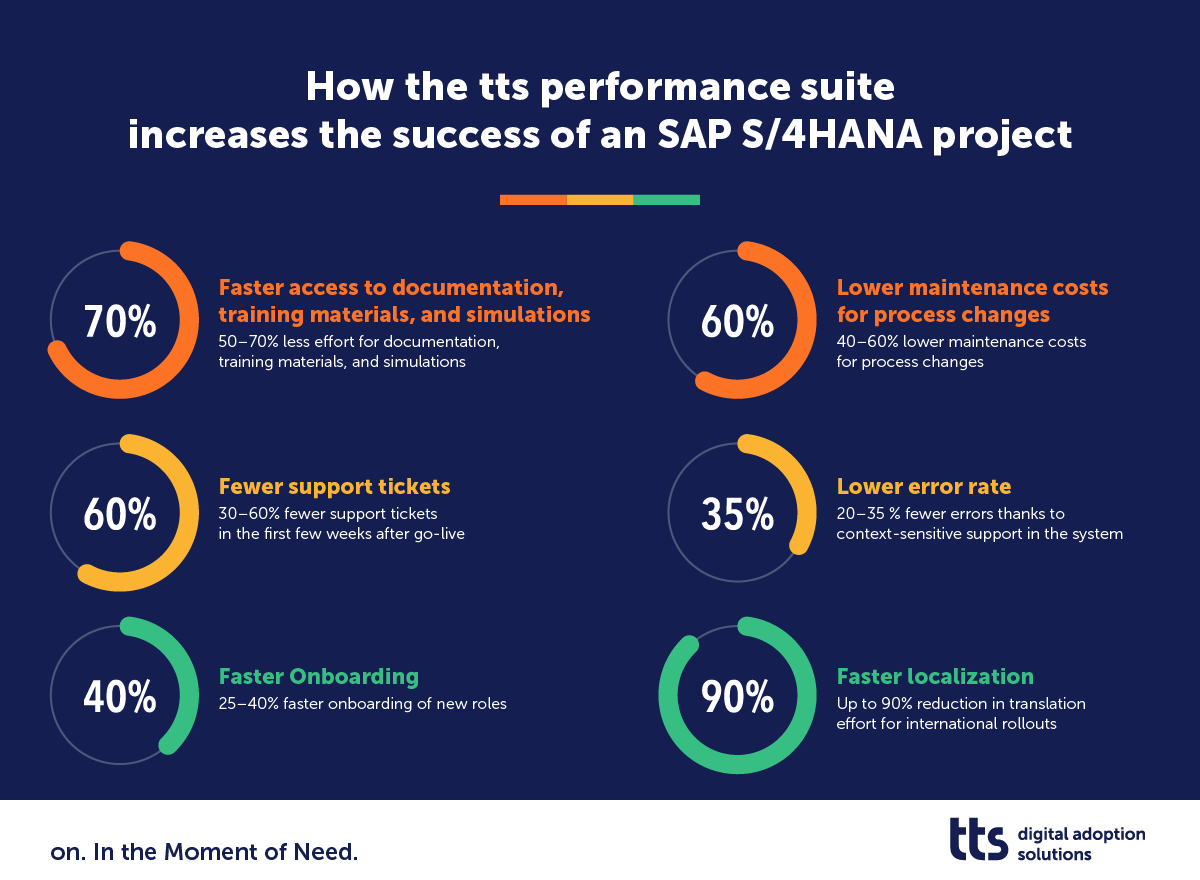
Significant efficiency gains can already be observed during the project phase. Experience shows that standardized content creation reduces the effort required for documentation, training materials, and simulations by 50 to 70 percent. Materials are available earlier, test cycles are shortened by 20 to 30 percent, and coordination between departments runs more smoothly. At the same time, dependence on individual key users is significantly reduced, as knowledge is centrally recorded and widely available.
Further effects become apparent when the system goes live. Organisations report a 30 to 60 percent reduction in support tickets in the first few weeks because context-sensitive support answers many queries directly in the workflow. The training period for new roles is noticeably shorter, often by 25 to 40 percent, as employees require less training time and become productive more quickly.
The platform also provides a stable basis for ongoing operations. Process changes can be updated centrally and are immediately available in all formats – an advantage that reduces maintenance cost by an average of 40 to 60 percent. Documentation remains consistent, and compliance or audit requirements can be met more reliably. At the same time, in-app help supports process quality in everyday work, which can reduce error rates by 20 to 35 percent, depending on the area.
The impact is particularly evident in international projects. Automated translations reduce the localization effort for context-sensitive help by up to 90 percent. Rollouts in other countries are faster, and language barriers lose their relevance.
These effects ensure that S/4HANA projects become more predictable, transition to stable operation more quickly, and incur lower costs in the long term. This is precisely where the tts performance suite demonstrates its strategic value: it makes complex transformations manageable and success measurable.
Conclusion: Why the tts performance suite is the best DAP for SAP S/4HANA
An S/4HANA transformation places high demands on speed, quality, and consistency in user enablement. Traditional approaches using Word, PowerPoint, and manual screenshots inevitably reach their limits. To remain competitive, organizations need a comprehensive approach that combines documentation, training, and support in the workflow and adapts flexibly to changes.
The tts performance suite meets precisely these requirements. It creates a consistent content lifecycle, significantly reduces the effort required for documentation and training materials, and makes knowledge available where it is needed: directly in the system. At the same time, it relieves key users, accelerates international rollouts, and ensures that process knowledge within the organization remains stable and up to date.
This transforms a technical SAP transformation into an organizationally sustainable change. Employees find their bearings more quickly, support and project teams are relieved of some of their workload, and the organization benefits from higher process quality in its day-to-day operations. The tts performance suite accompanies you on this journey not only through the go-live, but throughout the entire lifecycle of S/4HANA and beyond.
FAQ: Frequently asked questions about digital adoption in SAP S/4HANA projects
What is a Digital Adoption Platform (DAP) and what is it used for in S/4HANA projects?
A Digital Adoption Platform helps employees to use complex applications confidently. In S/4HANA projects, it is used to provide knowledge directly in the workflow and to supplement traditional training formats. Instead of conveying content as isolated documents, a DAP guides users step by step through transactions, processes, or new functions. It thus helps to reduce uncertainty, minimize errors, and increase productivity from day one.
How does the tts performance suite support the success of an S/4HANA go-live?
The tts performance suite prepares users specifically for the go-live by providing documentation, training materials, simulations, and e-learning from a central source. Shortly before go-live, context-sensitive support in the SAP system ensures that questions are answered directly in the workflow. This reduces support tickets by up to 60 percent, shortens training times, and stabilizes processes in the critical initial phase. Teams can concentrate on their tasks without being slowed down by constant queries.
How does single source of truth content creation work in the tts performance suite?
The platform is based on the principle of “record once, use many times.” An SAP process recording serves as a central source of knowledge. Various formats can be automatically generated from it: documentation, work instructions, training materials, simulations, or e-learning modules. Changes to the process are incorporated into all formats without the need to maintain content multiple times. This significantly reduces the effort required for creation and maintenance and ensures that all participants always work with consistent material.
How does context-sensitive support work in the SAP system?
Context-sensitive help recognizes where a person is in the SAP system—for example, in a specific Fiori app or transaction—and displays exactly the information that is needed at that moment. This can be step-by-step instructions, explanations, videos, or simulations. Users remain in the system and receive support in their natural workflow. This real-time assistance ensures that fewer errors occur and significantly reduces the workload on specialist departments.
How does the tts performance suite relieve key users in S/4HANA projects?
Key users are among the most heavily burdened roles in an S/4HANA project. They test processes, explain procedures, answer questions, and provide training support. The tts performance suite reduces their workload by making knowledge available centrally. Recurring questions are answered by context-sensitive help directly in the system, training materials are generated automatically, and process changes can be updated in all formats without manual rework. Key users gain time for technical decisions, tests, and coordination—the tasks for which their expertise is really needed.
How does the tts performance suite promote end-user enablement in S/4HANA projects?
End users gain access to a constantly updated knowledge base that guides them through new or rarely used processes. Learning content is not taught once and for all, but revisited in everyday work – exactly when it is needed. Simulations enable risk-free practice, e-learning courses teach the basics, and context-sensitive support closes knowledge gaps in real time. This increases confidence in using the system and significantly flattens the learning curve.
How does tts performance suite support global rollouts and multilingualism?
International S/4HANA projects benefit particularly from the integrated translation functions. Content—from documentation to in-app help—can be automatically translated into different languages. All language versions remain synchronized throughout the entire lifecycle. Context-sensitive help also offers the option of displaying content on demand in the user's native language, without any manual translation effort. This reduces language barriers, speeds up rollouts, and significantly reduces the workload for local teams.


