

Performance Management: From Performance to Development
Show me similar content
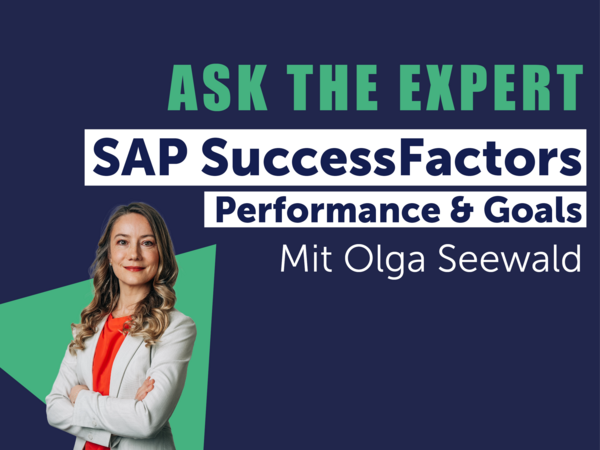
SAP SuccessFactorsIn this episode of the “Ask the Expert” series, Olga Seewald, Lead Expert of the tts Performance and Goals Community, talks about the future of Performance Management. She explains why traditional goal agreements are hitting limits and why companies in the DACH region are increasingly relying on flexible cycles, feedback culture, and development management. She also demonstrates how SAP SuccessFactors Performance & Goals technically supports these changes and what role AI plays in identifying potentials. Her conclusion: The future lies not in pure evaluation, but in developing and empowering employees.

With our interview series “Ask the Expert”, we regularly provide insights into the key HR tech topics surrounding SAP SuccessFactors. In this episode, Olga Seewald, Lead Expert of the tts Performance and Goals Community, discusses the evolution of Performance Management. She explains why traditional goal agreements are reaching their limits, how companies in Germany, Austria, and Switzerland are rethinking feedback – and what role artificial intelligence will play in the development of employees in the future.
[Note: The text has been slightly adjusted and revised for written publication]
Motivation in Projects: Start and Go Live
Question: What motivates you more - the start of an implementation project or the Go Live?
Olga Seewald: Both motivate in their own way. At the beginning, it is curiosity and anticipation: You do not yet know the client, dive into their processes, and together consider how best to implement the requirements using SAP SuccessFactors Performance & Goals. The appeal lies in the analysis, in discovering, and in the initial design.
At the end – after months of intensive collaboration – the motivation is different. You look back on a shared journey, on many workshops, discussions, and approaches to solutions. The Go Live is the moment when you hand over the result of this work to the users. It is the joy when the solution truly becomes usable, the team is proud, and the project creates a tangible added value. This contrast – curiosity at the beginning, pride at the end – creates the special appeal for me.
Classical target agreements under pressure
Question: How well do traditional goal-setting processes still work today?
Olga Seewald: In some organizations – especially where structures are stable and there is little dynamism – traditional goal agreements still function to some extent. However, overall we see a clear departure. Rigid annual goals no longer fit markets that can change within weeks or months.
The trend is clearly moving towards shorter cycles, flexible goals, and continuous feedback. Employees today want feedback and guidance more often, not just an annual conversation. This does not mean that old models will completely disappear. But they need to be supplemented by new formats. In DACH companies, which are heavily influenced by competition and a shortage of skilled workers, this change is particularly significant. Performance management is becoming a tool that promotes agility and adaptability.
Feedback culture as part of the learning culture
Question: What trends do you observe regarding feedback?
Olga Seewald: Feedback is taken more seriously and is no longer just a "nice-to-have." More and more companies understand: A tool alone does not ensure feedback. It requires culture, trust, and role models. Leaders must exemplify feedback, and employees need to learn how to give and receive it constructively.
What we observe: Feedback is increasingly understood as a component of the learning and development culture. It’s no longer just about evaluating performance, but about making organizations more learning-oriented and reflective. This is a real cultural shift. Particularly in the DACH region, where companies are often traditionally shaped, this step is important to keep pace in the international competition.
SAP SuccessFactors Performance & Goals: Flexibility Meets Change Management
Question: What do these developments in feedback culture mean for SAP SuccessFactors?
Olga Seewald: The Performance and Goals Module is extremely flexible. Technically, almost anything can be represented – from the classic annual review to ongoing coaching to hybrid formats. This flexibility is an advantage because companies are at different stages of maturity.
However, the real challenge lies in Change Management. One must clarify: Why are we assessing performance at all? Is it only about control, or is it about development and motivation? Only when the goal is clear, does the tool unleash its full potential. In projects in Germany and Switzerland, we see that clients benefit particularly when they design processes, language, and forms in a way that fosters trust and transparency. Then, an evaluation process becomes a real leverage for further development.
From Control to Development Tool
Question: How do you position performance management as a meaningful tool?
Olga Seewald: By shifting the conversation from the tool to the goals and impacts. Performance management should create clarity: What role does the leader play? When is the employee actively involved? What development perspectives arise from the evaluation?
When these questions are answered, meaning emerges. Processes and language can build trust – and a control system becomes an empowerment approach.
I also see a significant change: We are increasingly talking not about performance management, but about development management. This means: Making potentials visible, linking development to business needs, providing orientation. AI is enhancing this trend by recognizing skill gaps, suggesting learning paths, and providing individual recommendations. Especially companies in Austria and Switzerland are pioneers in this area because they invest heavily in talent development.
Artificial Intelligence: Opportunities and Limitations
Question: How does AI support performance management – and what are its limitations?
Olga Seewald: AI is a powerful analytical tool. It recognizes patterns: Who provides regular feedback? Who meets goals? Where do systematic differences occur? These insights are valuable because they help HR departments to adjust processes systematically.
But: AI is only as good as the data it receives. In the HR field, data is often incomplete, culturally influenced, or biased. And AI does not know individual biographies or personal circumstances. Therefore, it cannot replace human conversation.
The future lies in a symbiosis: AI provides data-driven impulses, humans interpret them, put them into context, and act based on values. This is how processes are created that are efficient and remain human.
Community knowledge as a success factor
Question: How do you support each other in the Performance & Goals Community?
Olga Seewald: Every customer is unique - and that is what makes our work exciting. Processes differ, cultures vary, and systems are evolving. In our community, we continuously exchange experiences and best practices. Sometimes a brief exchange is enough to receive the crucial hint for a project.
Our strength lies in the fact that no one needs to know everything - but together we know a lot. We see ourselves as a learning organism that is constantly growing. For customers in the DACH region, this means: Even if they are only working with one consultant, the entire knowledge of the community is integrated into their projects.
Uncomfortable truths in performance management
Question: What is the least popular truth about performance management?
Olga Seewald: That it is sometimes uncomfortable. Performance management also means creating clarity – and that doesn't always feel good. Feedback can hurt, evaluations can be uncomfortable.
But this is where change begins. When it hurts, it's a sign that something needs to be adjusted. This honesty is not popular, but necessary. Only in this way can performance management become a tool that enables real change and development.
Conclusion: From Performance to Development
Performance management is changing – moving away from a control system towards a development-oriented approach. Companies in Germany, Austria, and Switzerland are increasingly focusing on a culture of feedback, flexible goal cycles, and AI-supported potential analysis. With SAP SuccessFactors Performance & Goals, these trends can be technically implemented, but the true challenge remains change management. Olga Seewald demonstrates: The future lies not in mere evaluation, but in developing and empowering employees.
Show me similar content
SAP SuccessFactors


