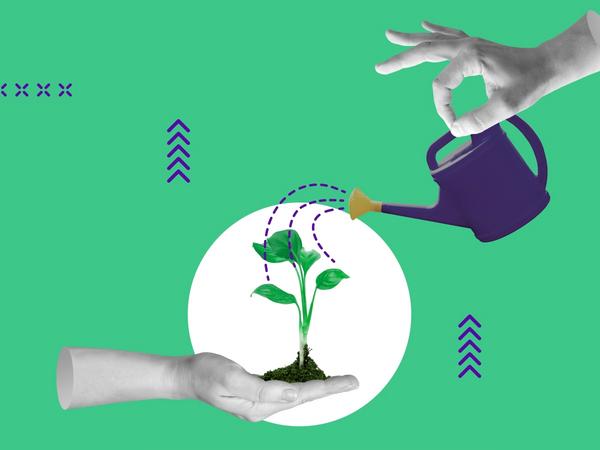


From Flower Pot to Garden – How Modern Talent Management Enables Growth
The classic talent management reaches its limits in times of rapid skill changes. Leo Bättig, Managing Director of tts Switzerland, demonstrates in his webinar how companies can shape the transition to a development-oriented talent management – with a focus on skills, feedback, and personal responsibility. Technology such as SAP SuccessFactors becomes an enabler, while culture is the crucial success factor. Whether corporation or SME: those who want to nurture talent must relinquish control – and cultivate trust.

If talent is allowed to take root
Talents do not grow on their own. They need space, light, and nutrients – or, as Leo Bättig put it in his webinar: “Trust, vision, and learning opportunities.”
The classical talent management has long tried to identify and manage potential. However, in a work environment where job profiles, technologies, and expectations are changing faster than ever before, that is no longer sufficient. Companies must create an environment where employees can develop independently – an ecosystem for continuous learning instead of a greenhouse full of processes.
Leo Bättig, tts Switzerland
Classical talent management was long an administrative system – today it is about creating spaces for growth.
Why traditional talent management is hitting its limits
The half-life of knowledge is decreasing, new technologies are transforming job profiles – and organizations must keep up. According to the Future of Jobs Report 2023 by the World Economic Forum, around 23% of all jobs are changing so significantly that they need to be rethought or replaced.
Where Excel lists and succession plans used to dominate, today agile structures are needed that make competencies visible, open up learning opportunities, and empower employees to take their development into their own hands. The shift from talent management to talent development is therefore not only semantic but also cultural.
Three Principles for Development-Oriented Talent Management
How does this change succeed in practice? Bättig outlines three fundamental principles that shape modern talent management – regardless of company size or industry – in the webinar.
1. Skills instead of Job Profiles
Roles change, but skills remain. Instead of thinking in fixed positions, the focus shifts to the competency portfolio of employees. Companies that develop their talents based on skills rather than job titles can respond more agilely to market changes – and deploy talents where they have the greatest impact.
2. Responsibility instead of Control
In many organizations, HR has been the guardian of the process: performance reviews, goal agreements, succession planning. Development-oriented talent management reverses this logic. Employees define their own development goals, propose learning paths, and actively seek feedback. Leaders support – rather than control. This requires the courage to let go, but brings forth a new form of engagement.
3. Feedback as a Learning Engine
Growth occurs where reflection is possible. Regular, constructive feedback – from colleagues, supervisors, and project partners – is the key. Bättig emphasizes that while feedback processes exist in many companies, they are rarely lived. A continuous dialogue replaces rigid annual reviews. Development becomes an everyday component, not a one-time ritual.
Leo Bättig
Technology can stimulate development – but culture determines whether it also grows
Talent Management with SAP SuccessFactors – Technology as an Enabler
Technology can support this change – but it must not dictate it.
In the webinar, Leo Bättig demonstrated, using SAP SuccessFactors, how development goals, learning content, and feedback can be integrated into one system. Employees can create their own goals, receive learning recommendations, and manage their competency profiles across the board. AI-powered features suggest suitable training or project opportunities.
The strength of such platforms lies in their interplay: development goals, learning libraries, mentoring programs, and internal talent marketplaces interconnect. This creates a holistic picture of skills, interests, and potentials – visible to both employees and companies at the same time.
Talent management for SMEs – feasible even without corporate structures
What does this mean for small and medium-sized enterprises that do not have their own HR department with system administrators?
In the Q&A section of the webinar, Bättig made it clear that talent management does not fail due to company size. It is crucial to choose the right solutions – systems that remain manageable while still allowing for development.
For SMEs, talent management primarily means promoting dialogue: executives and employees should regularly discuss learning goals, interests, and perspectives. Many development measures occur anyway – they are just not made visible as such.
Those who systematically accompany and document internal training, project work, or mentoring lay the foundation for a learning organization – even without a large software landscape.
Cultural Change: From Control to Trust
Whether it's a corporation or an SME, cultural change is at the center.
Traditionally, talent management was closely linked to evaluation and remuneration. Development goals were discussed in the same conversation as bonuses. However, those who open up in an assessment context reflect less honestly.
A development-oriented talent management separates these worlds: performance discussions look back, development dialogues look forward. Employees reflect on strengths, interests, and learning areas – without fear that this will affect their evaluation.
Bättig describes this change as a long-term process: leaders must learn to share responsibility, give trust, and accept feedback. Organizations, in turn, must learn to think of development more broadly – not only vertically but also laterally and project-related.
Thus, a culture emerges in which learning becomes part of everyday life – not an exception, but an expectation.
First Steps in Practice
Many of the measures discussed in the webinar can be implemented immediately – even without major system changes. The main points of approach:
- Separate development goals from the performance process. Separate conversations create space for the future instead of evaluation.
- Structure feedback. A simple method like Start–Stop–Continue helps to shape feedback constructively.
- Make skill profiles visible. Define five to ten core competencies together with employees – as a basis for learning paths.
- Involve leaders. Without leadership commitment, talent management remains an HR project.
- Develop a vision. Companies should define what "development" means to them – professionally, personally, and organizationally.
Bättig advises starting small: a pilot team, a workshop, a first development dialogue. This is how cultural change can grow organically – like a garden that needs care but does not have a finished concept.
Leo Bättig
Development-oriented talent management means making potential visible – not evaluating it.
Conclusion – From Flower Pot to Garden
When companies manage talent, they remain in the pot. When they allow them to grow, a garden is created – diverse, vibrant, resilient.
Modern talent management means giving employees room for development and understanding leadership as enabling. Technology provides the nutrients, culture the climate, trust the light.
Those who begin this transformation invest not only in skills but in future viability.


